
Delivered virtually over four afternoons and two evenings in November 2020, the National Gallery of Australia’s Know My Name Virtual Conference brought together leading and emerging Australian and international voices from arts and academia.
The conference was held in the lead up to the opening of the major exhibition ‘Know My Name: Australian Women Artists 1900 to Now’, which celebrates the work of all women artists with an aim to enhance understanding of their contribution to Australia’s cultural life.
Foregrounding First Nations perspectives and diverse voices — and with inclusion and best practice accessibility as a key priority — the conference considered historical and contemporary experiences of gender and feminism in the arts. The program included keynote presentations, in conversations, panels discussions, live Q&A’s, artist performances and breakout sessions.
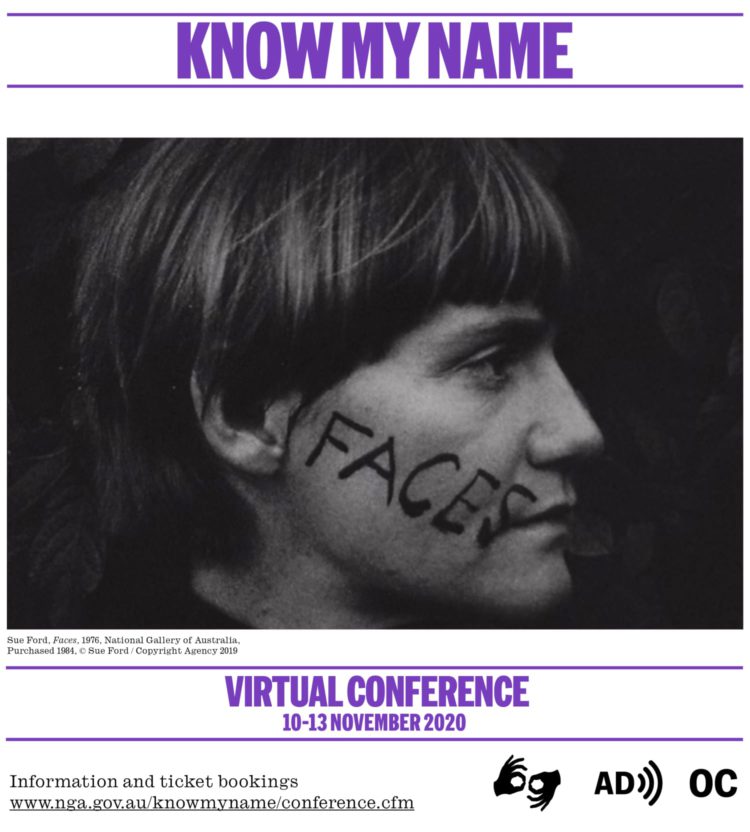
While a virtual event was necessary due to the restrictions from COVID-19, the Gallery had already been looking for ways to connect with broader national audiences. The challenge was to run an engaging virtual conference that would allow voices from all backgrounds and abilities to participate — while establishing a blueprint for virtual events moving forward.
The Know My Name Virtual conference would be inviting a diverse group of artists, academics, curators, and writers from across the world to discuss representation in the arts. The National Gallery’s main objective was to host a conference that could really dive into the issues around gender equity and representation in the arts. When moving this event online, they didn’t want anyone to feel they were getting a secondary experience.
Evise used their extensive experience in events and technology to bring the National Gallery’s vision to life.
Working with technology partner, Entegy, Evise facilitated a shared experience on a single platform, while also providing accessibility options including live captioning, AUSLAN and audio descriptors.
Delivered on a purpose-built platform, the conference enabled delegates to select from three discreet access experiences. Depending on preference, participants experienced the conference with Auslan interpretation and captions, with audio description, or with video and audio only, while participating in a single, shared discussion and live questions board. Accessibility enabled diverse and inclusive participation that ensured rich conversations around barriers to recognition and success in the visual arts for all women. It also demonstrated the National Gallery’s commitment to representation and inclusion.
Because Entegy technology focuses on community platforms and attendee engagement, Evise was able to facilitate an inclusive discussion room, combined with multiple streams for accessibility — just as the National Gallery hoped. As one attendee put it, “the discussion room is integral to the experience of being in the space and the conversion”. Many other technology partners could provide the accessibility elements, but not a combined discussion room.
During the event, Evise director Kylie Clarke worked on-site in Canberra to facilitate the delegate experience. Kylie facilitated discussions and managed the event Q&A, while also providing live support to anyone who had issues with access. This allowed the NGA team to focus on content delivery.
Know My Name Program & Campaign Manager, Jessi England, explains. “Very few technology or event partners could deliver what we wanted in a single solution, but Evise put together an amazing proposal in a remarkable timeframe. They were able to facilitate the technology, but because Kylie and Jade also have a deep understanding of everything required to pull off a successful event, they were able to navigate us through unfamiliar territory. We wouldn’t have been able to do what we did without Evise,” says England.
In partnership with Evise, the event was a thought-provoking virtual experience that has subsequently been recognised as an exemplar for the disability and visual arts community for digital engagement in Australia.
While being able to provide the right technology was crucial to being able to deliver the accessibility elements of the conference, NGA credits much of the event’s success to the professionalism and collaboration from Evise and their event team. Evise worked closely with NGA and external event producers to provide support and guidance at every step.
“Kylie and Jade are great collaborators; they took the time to understand what we wanted and worked tirelessly to deliver it in the most seamless way. From our perspective it was such an easy process to undertake because of how well they worked as a consolidated team with us at NGA and our event producers.”
— Adriane Boag, Program Producer Access, National Gallery of Australia & Conference Co-Producer
“Kylie and Jade are such an impressive team to work with. They’re incredibly professional but also really warm and personal in their approach. What Evise could bring in terms of their knowledge and deliver across every element of what we required, was so fantastic.”
— Jessi England, Program & Campaign Manager, National Gallery of Australia & Conference Co-Producer
More than 900 people from six countries registered for the Know My Name Conference, with 6.5% taking up the accessibility options and participating actively in discussions.
“I was thrilled to see that the conference platform was made so accessible to enable a wide audience to take part. This is so important, and I hope will set the standard for other institutions going forward. Given the entire conference was virtual, I still felt as though I was situated in a public forum and loved that there were comment and question capabilities allowing for a very open conversation in real time.”
— Know My Name Virtual Conference attendee